Market outlook
Stable Outlook 7/10
The card has already matured into a widely recognized modern classic, so value is driven more by grade scarcity and player legacy than by speculative hype. Demand should remain strong, but abundant supply in lower grades limits rapid appreciation.[1][3][5]
Next months. Likely to remain steady with modest price movement, strongest in graded 9-10 and other premium certified examples.
Long term. Expected to hold blue-chip status with gradual appreciation in top grades, while raw and mid-grade copies should stay liquid but mostly range-bound.
History
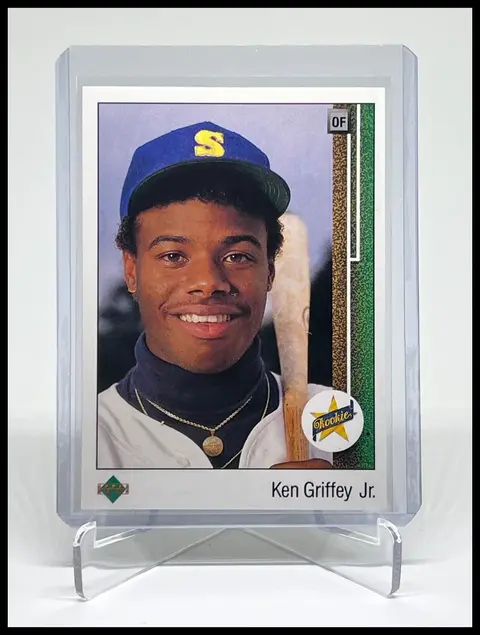
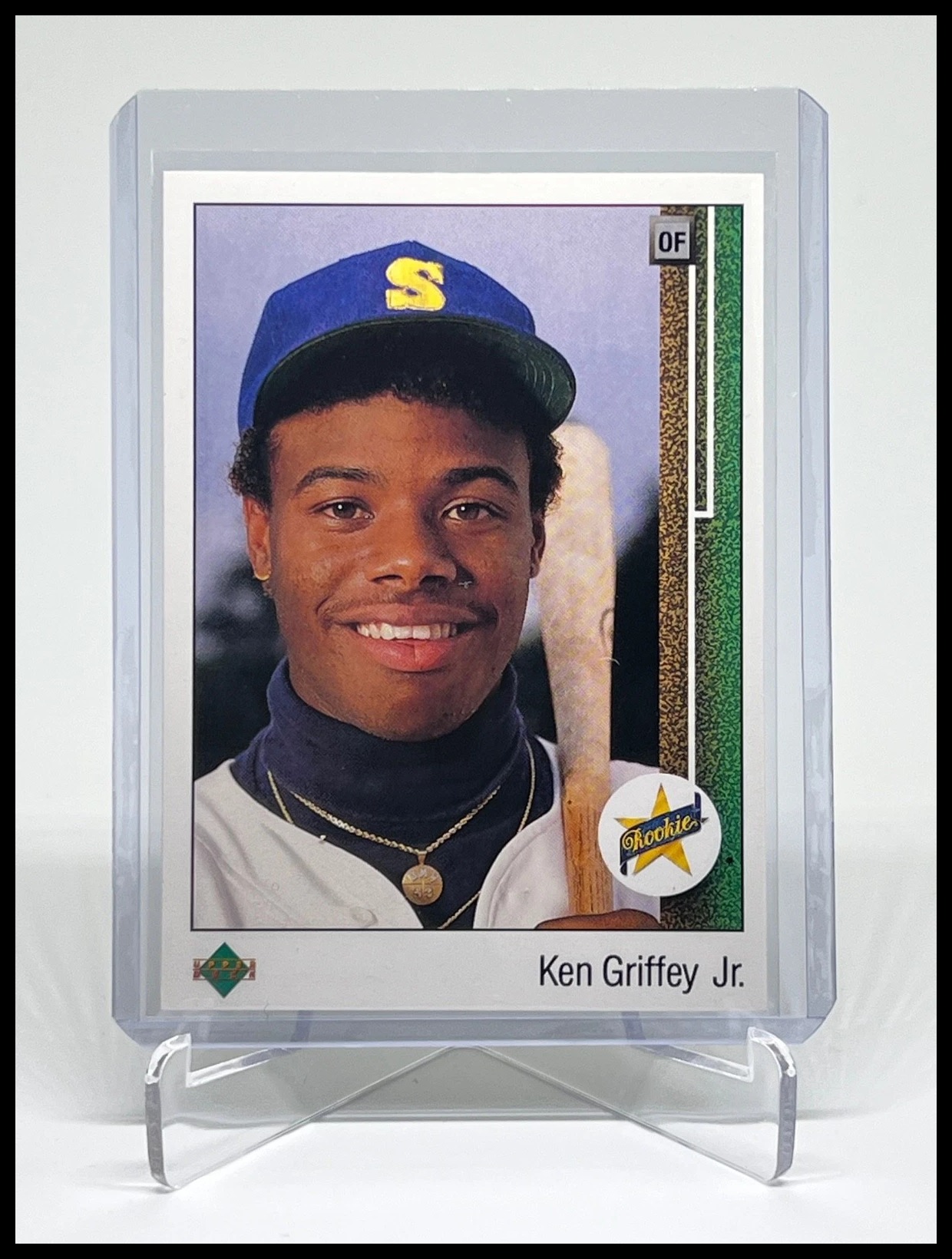
Ken Griffey Jr. is one of the most important players of the modern baseball era, known for elite all-around talent, a smooth left-handed swing, exceptional defense, and major star power with the Seattle Mariners and later the Cincinnati Reds. His Hall of Fame career and broad cultural popularity made his rookie cards, especially the 1989 Upper Deck #1, among the most iconic baseball cards of the late-1980s hobby boom.[1][5]
First released in 1989 as card #1 in the 1989 Upper Deck baseball set, distributed in Upper Deck packs that year. The card is part of Upper Deck's low-number portion of the set, which was more desirable for Griffey hunters than high-number packs.[1][5]
- This card is widely regarded as the key rookie card of Ken Griffey Jr. and one of the most symbolic modern-era baseball cards.[1]
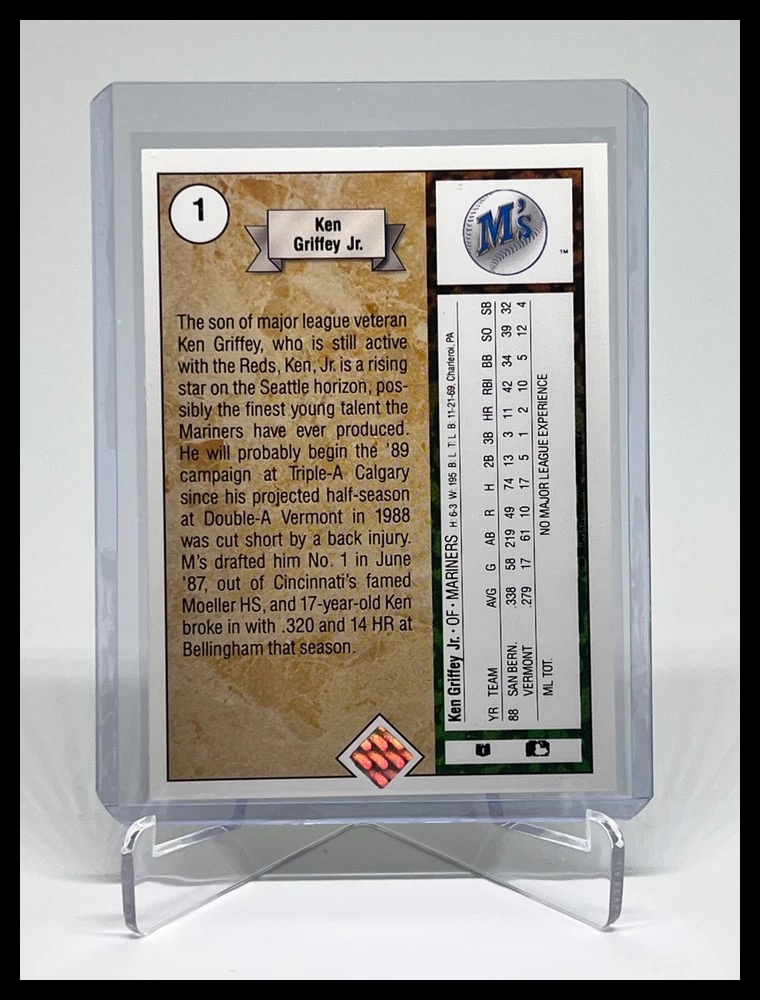
- Many copies have a factory wrinkle on the reverse that can severely limit the grade even when the front appears near mint; graded notes this flaw commonly caps affected copies around graded EX-MT 6.[1]
- The card is a 'Star Rookie' designation card, and hobby discussion has long noted back-hologram and printing inconsistencies, though not all are recognized as true variations by grading companies.[1][2][4]
Rarity and print run
- Tier
- Uncommon
- Print run
- Very High
- First printed in
- 1989 Upper Deck Baseball
- Demand
- Very High
- Supply
- Abundant
- Base copies are not truly scarce because the card was produced in very large quantities during the 1989 Upper Deck run.
- Gem Mint copies are much harder to obtain due to centering, surface, and back-flaw issues.
- The back factory wrinkle and hologram-related defects reduce the number of top-grade survivals.[1]
Collector notes
Condition. Check centering, corner sharpness, edge wear, surface gloss, and especially the back of the card for the factory wrinkle noted by graded. The back hologram area is also critical; misalignment, partial missing hologram, or heavy wear can reduce grade. Because the card is from the junk-wax era, near-mint examples are common, but truly high-grade copies are much harder to find.[1][2][3]
Storage. Store in a rigid penny sleeve and top loader or semi-rigid holder, keep away from heat and humidity, and avoid repeated handling of the back surface and hologram area. For high-grade submissions or long-term preservation, use archival-quality materials and minimize any pressure on the card to avoid creating surface dents or wrinkles.
Authenticity. Confirm the card has the correct Upper Deck stock, printing quality, back hologram, and front design consistent with the 1989 issue. Be cautious of altered cards, trimmed edges, and reprints; the card's popularity makes it a target for counterfeits. Variations such as small print flaws, hologram differences, or tiny marks are discussed in the hobby, but grading companies generally do not treat most of these as major recognized variations.[1][2][4][6]