Market outlook
Stable Outlook 3/10
Prices are already low and supply is plentiful, so the card is likely to move mostly with broader Tiger Woods collecting interest rather than scarcity-driven spikes. High-grade examples may maintain modest premiums, but the common nature of the card limits upside.
Next months. Likely to remain in a narrow low-price range, with graded examples commanding small premiums over raw copies.
Long term. Expected to stay stable with modest appreciation at most, unless Tiger Woods-related collecting surges or sealed-product interest increases significantly.
History
Tiger Woods is one of the most significant figures in golf history, turning professional in 1996 and quickly becoming the sport’s defining global star. He brought unprecedented athleticism, distance, and mainstream visibility to golf, breaking barriers as a multicultural icon and helping drive major growth in golf card collecting. Cards from early-2000s Tiger Woods issues are collected both for his legacy and for nostalgia tied to his peak popularity.
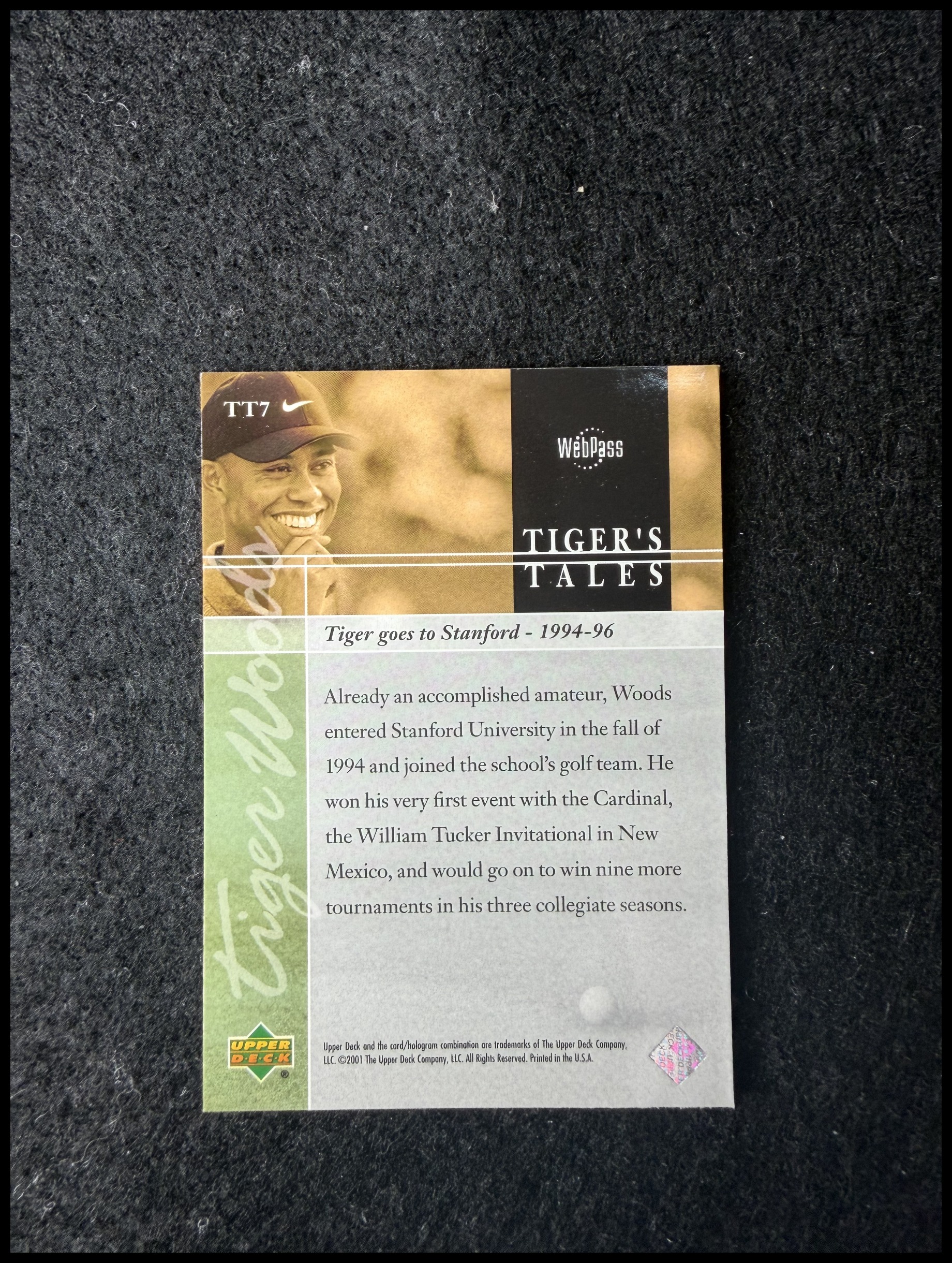
This card was first released in 2001 as part of Upper Deck’s Tiger Woods golf card line, specifically the Tiger's Tales insert/subset numbered TT7. The set is associated with the 2001 Upper Deck Tiger Woods Collection/Tiger's Tales products released in the United States.
- TT7 is part of the 2001 Upper Deck Tiger's Tales sequence, which includes multiple Tiger Woods cards numbered in order.
- Market listings and price guides consistently place this card among low-value common Tiger Woods cards rather than a premium short print.
- The card is widely available in the market, and graded auction data shows the Tiger's Tales set contains multiple Tiger Woods entries with substantial population counts.
Rarity and print run
- Tier
- Common
- Print run
- Very High
- First printed in
- 2001 Upper Deck Tiger's Tales
- Demand
- Medium
- Supply
- Abundant
- No evidence of short-print status in the available sources.
- High availability in marketplace and price-guide data.
- Common insert/subset numbering within a widely collected Tiger Woods release.
Collector notes
Condition. Check centering, corner whitening, edge wear, and surface scratches, especially because modern-era glossy Upper Deck cards can show print lines and scuffing. Graded examples are common, so higher-grade copies need clean edges, sharp corners, and strong centering to stand out.
Storage. Store in a penny sleeve and rigid top loader or semi-rigid holder, away from moisture, heat, and direct light. For long-term preservation, keep the card in an acid-free sleeve and use storage that prevents warping and surface friction.
Authenticity. Authentic copies should match the standard 2001 Upper Deck printing style, stock, and numbering format for TT7. Because the card is not especially rare, the main authenticity check is consistency of print quality, logos, numbering, and stock rather than advanced anti-counterfeit features; oversized margins, blurry text, or incorrect gloss can indicate a fake or altered reprint.
Sources: etsy.com, sportscardspro.com, psacard.com, aamintcards.com, cardladder.com