Market outlook
Stable Outlook 6/10
Price data shows a relatively stable market for raw copies and graded copies, with graded 10 commanding a premium but not showing evidence of extreme momentum. The card’s long-term value is supported by evergreen Eeveelution demand, while the large modern supply keeps growth measured.[1][3][5]
Next months. Likely to remain range-bound with occasional spikes from set nostalgia, grading submissions, or Eeveelution-focused buying activity.
Long term. Over 1-3 years, the card is more likely to appreciate gradually than sharply, with strongest gains concentrated in high-grade copies and well-centered examples.
History
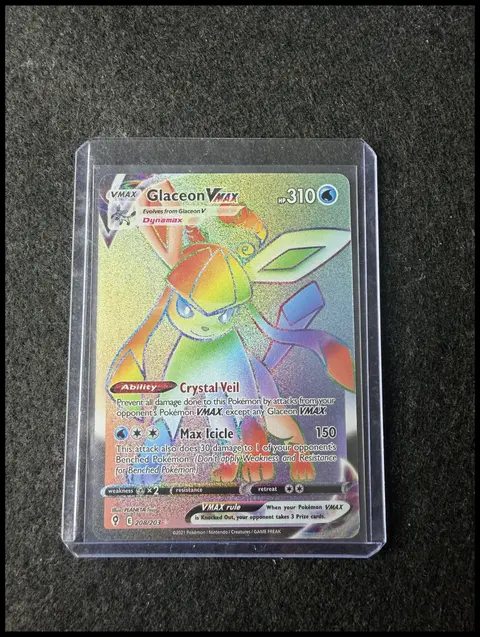
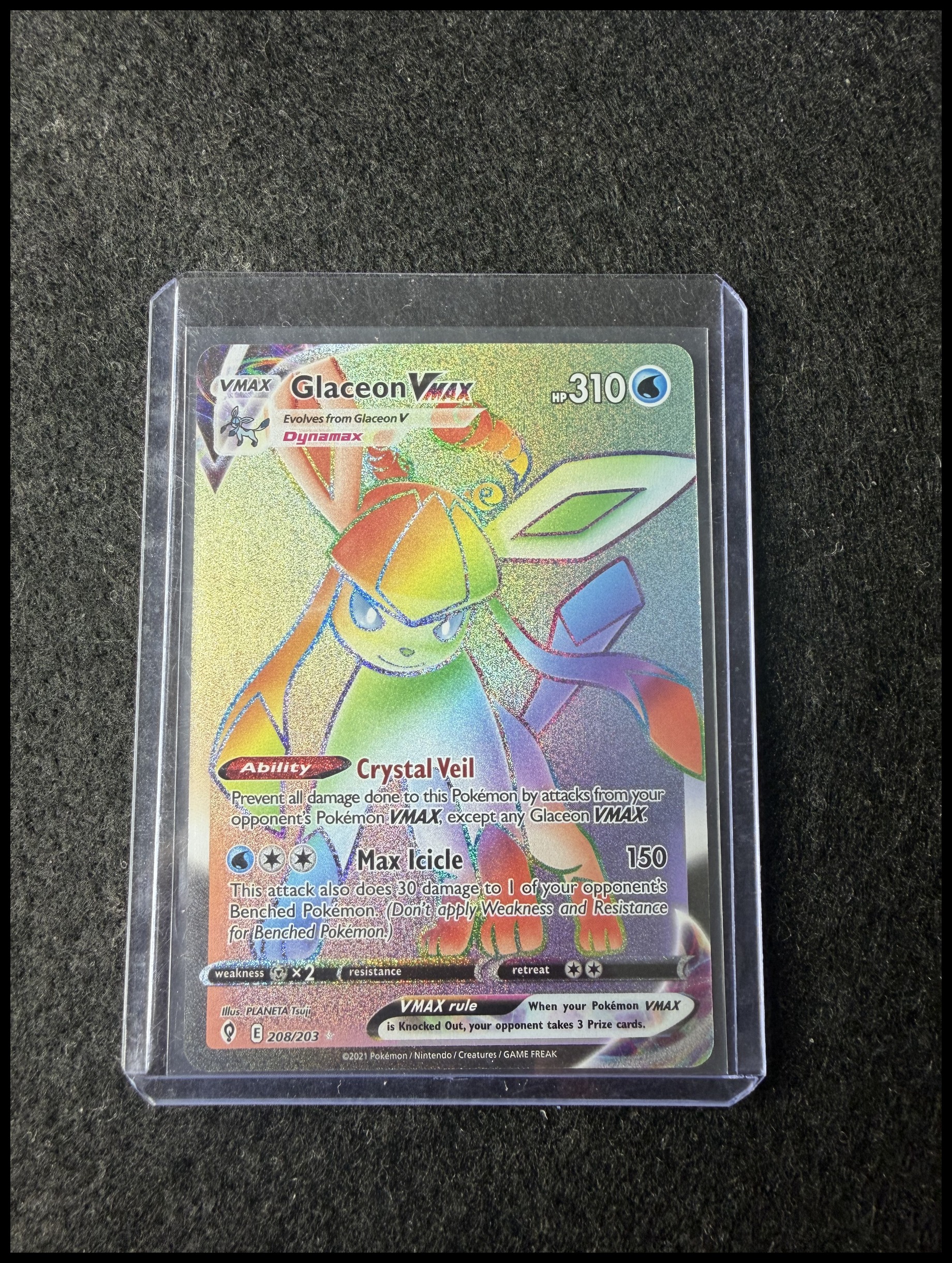
Glaceon is an Ice-type Eevee evolution introduced in the Pokémon franchise as part of Generation IV, originally appearing in the mainline video games before becoming a recurring favorite across the TCG and other media. As a VMAX card, this version depicts Glaceon in its Dynamax-inspired Gigantamax-era battle form from the Sword & Shield TCG era, and the card’s popularity is driven heavily by Eeveelution collector demand rather than gameplay dominance.[2][3]
First released in English in the Sword & Shield: Evolving Skies expansion in 2021 as card 208/203, a secret rare rainbow-foil printing of Glaceon VMAX.[1][2][3]
- This is a secret rare rainbow variant, numbered 208/203, which means it is numbered beyond the main set list.[1][2][3]
- The card is associated with the Eeveelution lineup, one of the strongest collector-driven segments in modern Pokémon TCG.[2][3]
- Market data shows it trades at a relatively modest raw price compared with other Eeveelution chase cards, but graded 10 copies command a clear premium over lower grades.[1][5]
Rarity and print run
- Tier
- Secret Rare
- Print run
- High
- First printed in
- Sword & Shield: Evolving Skies
- Demand
- High
- Supply
- Medium
- Secret rare numbering beyond the main set list
- Rainbow variant appeal
- High collector demand for Glaceon and Eeveelutions
- Modern-era print volume is substantial, limiting scarcity
Collector notes
Condition. Check the rainbow holo surface for scratching, edge whitening, centering issues, and corner wear. Secret rares from this era often show print lines, roller marks, and surface abrasions that are easy to miss under normal light. Because the card is a dark-background VMAX rainbow print, whitening and corner fray are especially visible.
Storage. Use a penny sleeve and semi-rigid or top-loader immediately, keep it away from humidity and heat, and store it upright to reduce edge pressure. For high-grade copies, consider a team bag or graded slab to preserve centering, corners, and surface condition.
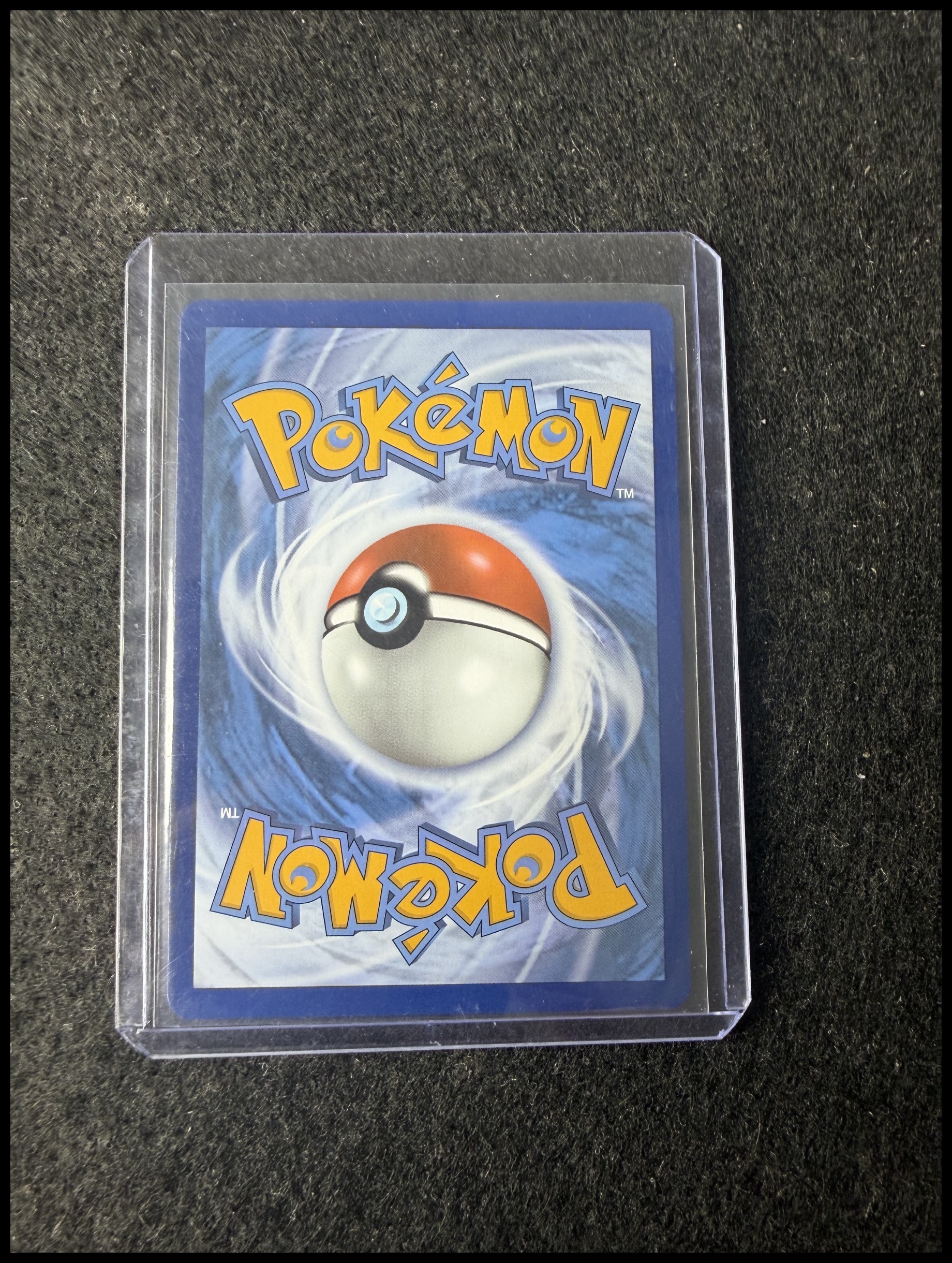
Authenticity. Authentic copies should show crisp rainbow foiling, correct Pokémon font, and sharp print registration. Fakes often have washed-out holo patterns, incorrect texture or gloss, blurry text, and inconsistent card stock thickness. Compare the card number, set symbol, and secret rare formatting against verified examples before buying raw copies.
Sources: hobbyscan.com, sportscardinvestor.com, tcgplayer.com, pokedata.io, psacard.com