Market outlook
Stable Outlook 7/10
The card has enduring blue-chip appeal because of Gibson's legacy, but broad print supply keeps raw-card pricing steady. Higher-grade copies should remain supported by collector demand and registry competition.
Next months. Expect mostly stable pricing with occasional spikes for premium-graded examples or strong auction visibility.
Long term. Likely gradual appreciation in higher grades, while low- and mid-grade copies should remain relatively stable with modest gains.
History
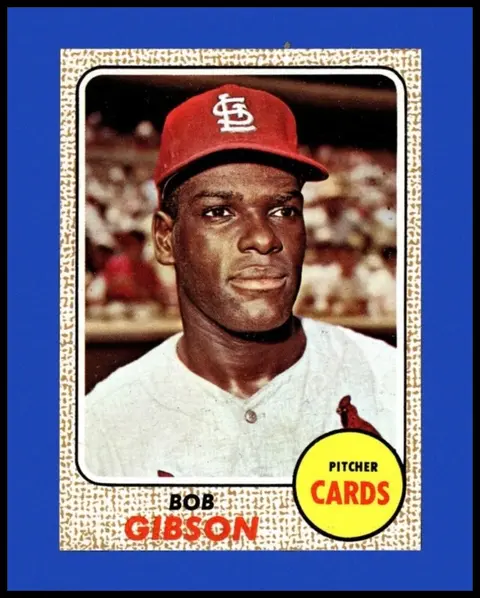
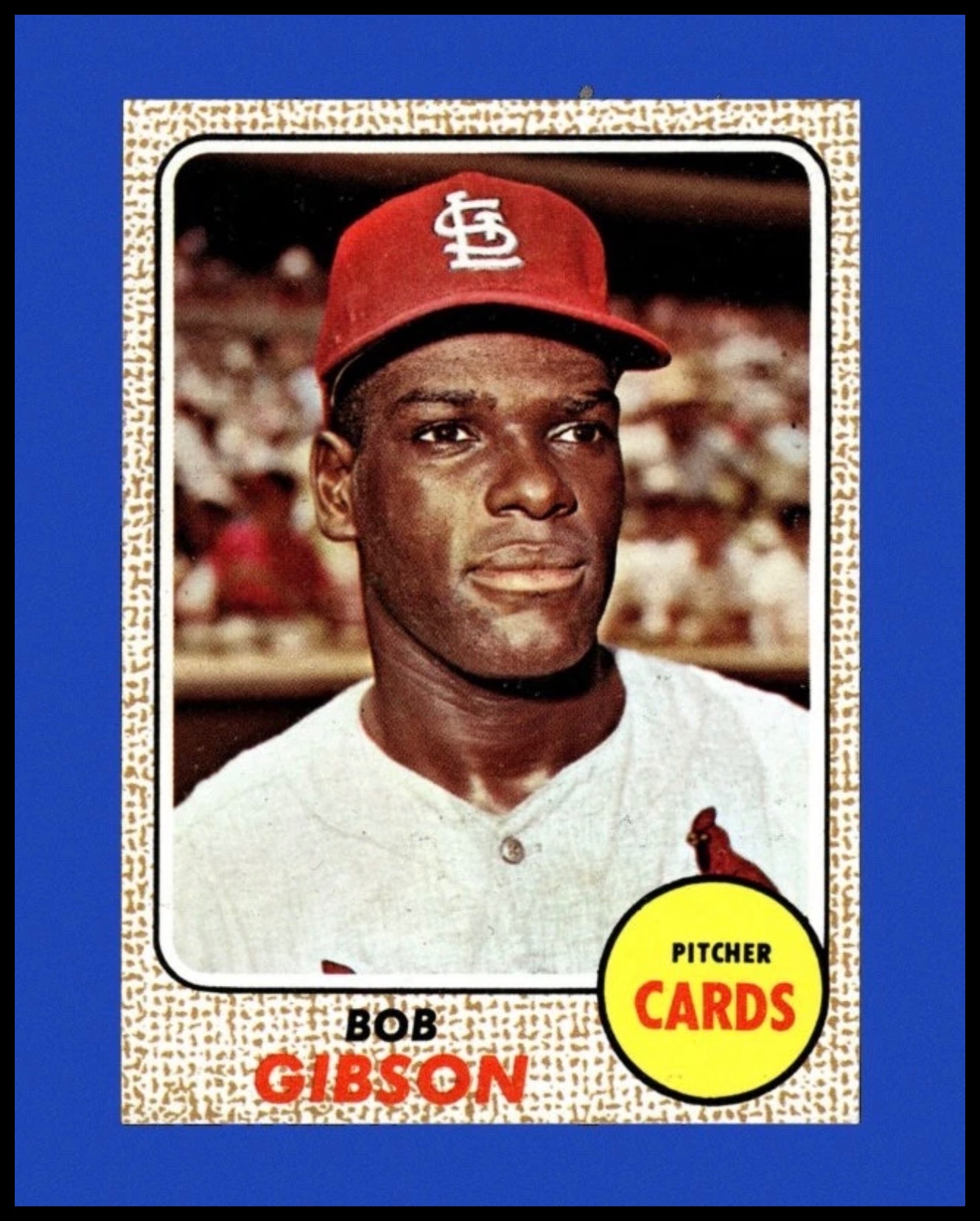
Bob Gibson was a Hall of Fame right-handed pitcher for the St. Louis Cardinals, renowned for his intimidating presence, overpowering fastball, fierce competitiveness, and elite command. The 1968 season cemented his legacy, as he posted a 22-9 record with a historic 1.12 ERA, one of the greatest pitching seasons ever, helping define the so-called 'Year of the Pitcher.' His 1968 Topps card captures him at the height of his dominance and is one of the key postwar flagship cards for a modern-era pitching legend.
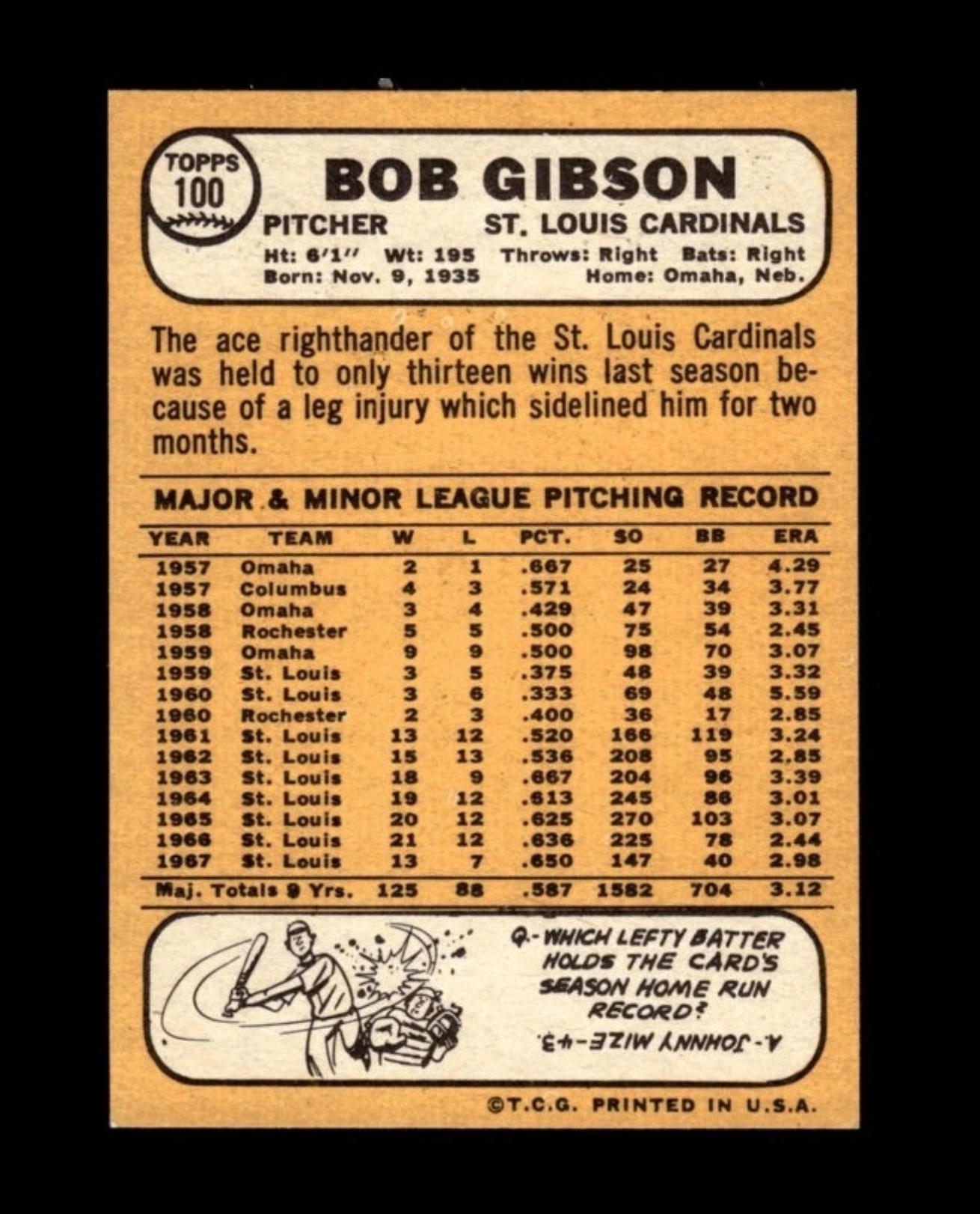
First released in 1968 as part of the Topps Baseball flagship set in the United States; card #100 appeared in the 1968 Topps regular issue checklist and is a standard 2.5" x 3.5" cardboard card.
- Card #100 in the 1968 Topps Baseball set.
- Bob Gibson is not a rookie on this card; it is a veteran star card from his peak era.
- His 1968 performance and Hall of Fame career make this a historically significant common-issue Hall of Famer card.
Rarity and print run
- Tier
- Common
- Print run
- Very High
- First printed in
- 1968 Topps Baseball
- Demand
- High
- Supply
- High
- Main issue is a mass-produced Topps flagship common-era card, so raw supply is plentiful.
- High-grade copies are scarcer because 1968 Topps is condition-sensitive, especially centering and corners.
- Demand is boosted by Bob Gibson's Hall of Fame status and iconic 1968 season.
Collector notes
Condition. Centering is a major value driver, followed by sharp corners, clean borders, and strong color. Common flaws include print snow, edge wear, corner whitening, surface scratches, wax staining, and off-centering, especially left-right.
Storage. Store in a penny sleeve and rigid top loader or semi-rigid holder, keep away from heat, humidity, and sunlight, and use archival storage materials. For higher grades, consider graded/slabbed storage to prevent handling wear.
Authenticity. Check stock, print quality, and 1968 Topps card stock texture; authentic examples usually show period-correct dot pattern, aging, and edge wear consistent with age. Suspiciously perfect corners, incorrect gloss, modern paper feel, or overly sharp image reproduction can indicate reprints. Compare typography, border tone, and card dimensions to known authentic copies.
Sources: psacard.com, sportscardspro.com, sportscardinvestor.com, sports.ha.com, deanscards.com