Market outlook
Stable Outlook 7/10
The card has long-standing collector demand tied to Willie Mays’ legendary status, and market pricing is primarily driven by grade and eye appeal rather than short-term speculation.[2][8][13]
Next months. Prices should remain firm for nice raw copies and strong graded examples, with premium centering and high-grade slabs continuing to command the most attention.
Long term. Likely gradual appreciation over 1-3 years, especially for graded 8+ copies and exceptional eye-appeal examples; lower grades should remain liquid but less volatile.
History
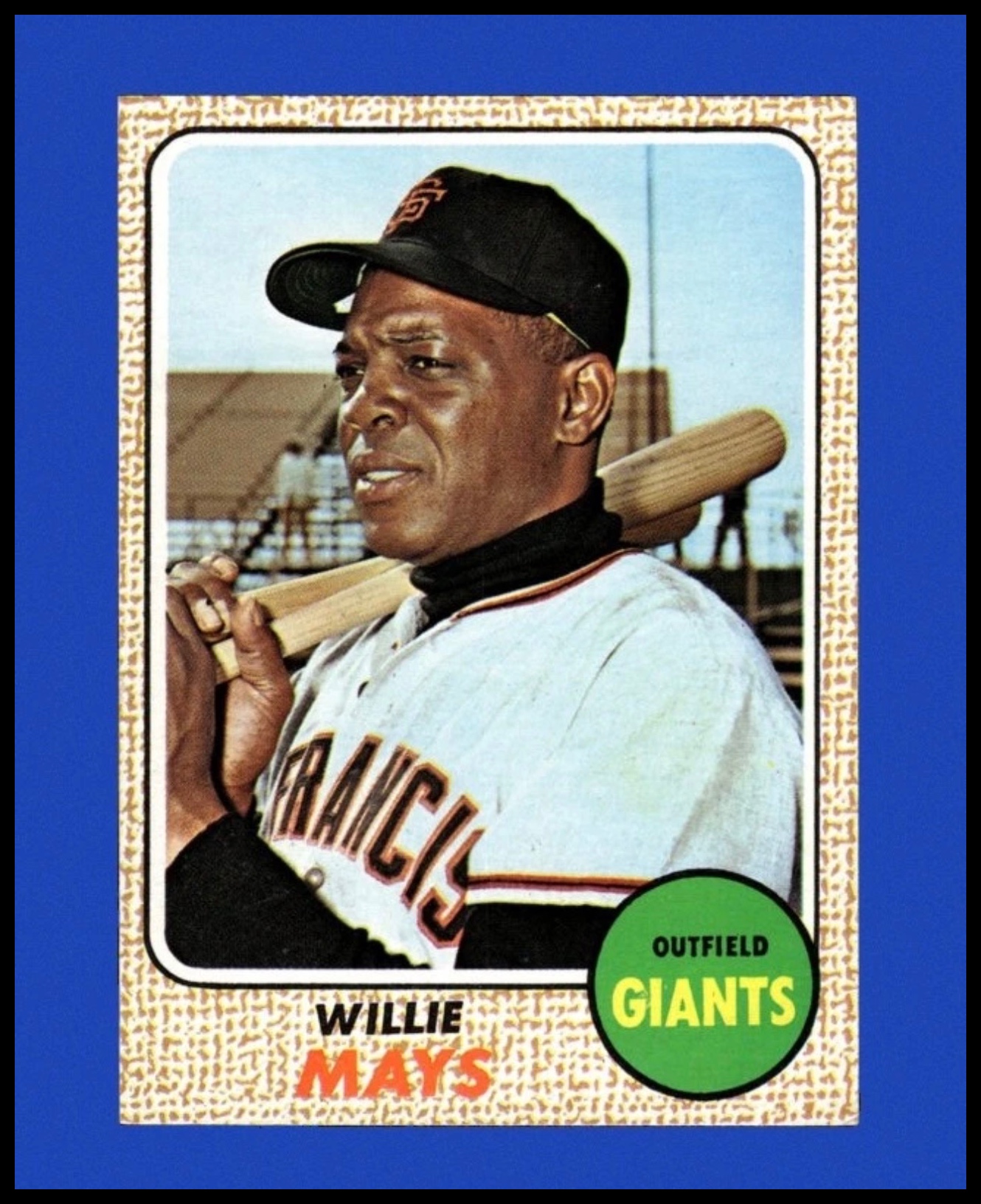
Willie Mays was one of baseball’s greatest all-around players, debuting in the Negro Leagues before becoming a generational star with the New York/San Francisco Giants. By 1968, he was already an established Hall of Famer and a defining face of 1960s baseball, which is why his card remains one of the key stars in the 1968 Topps set.[14][1]
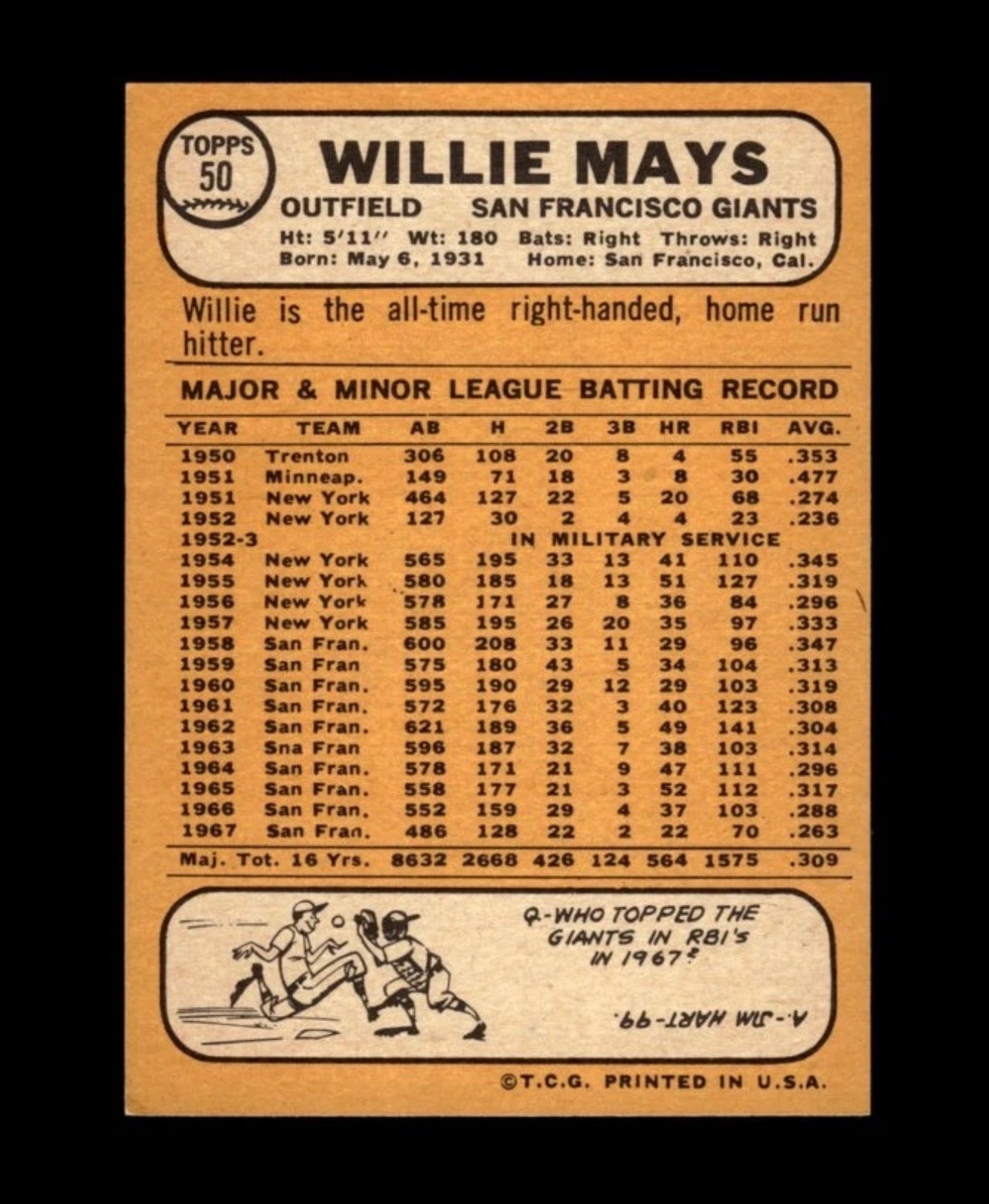
First released in the 1968 Topps Baseball set, card #50, distributed in packs in the United States as part of Topps’ 1968 baseball card issue.[14][1]
- Card #50 in the 1968 Topps Baseball checklist is Willie Mays with the San Francisco Giants.[14]
- Willie Mays is one of the most valuable and collected cards in the 1968 Topps set, with graded 10 sales reaching the tens of thousands of dollars.[2][13][15]
- The card is a base issue, but high-grade examples are heavily condition-sensitive and strongly affected by centering and print quality.[1][2][8]
Rarity and print run
- Tier
- Uncommon
- Print run
- Very High
- First printed in
- 1968 Topps Baseball
- Demand
- Very High
- Supply
- High
- Base-card production was high, so raw supply is plentiful.
- High-grade copies are much scarcer because centering, corners, and surface quality are difficult to preserve.
- As a key Willie Mays card, demand is elevated far beyond ordinary commons.
Collector notes
Condition. Check centering first, followed by corner wear, edge chipping, surface print defects, and back staining. Like many 1960s Topps cards, the card is especially sensitive to off-centering and corner rounding.
Storage. Store in a penny sleeve and rigid top loader or semi-rigid holder, keep away from humidity and direct light, and use an archival box for long-term storage. High-grade copies benefit from minimal handling and controlled temperature.
Authenticity. Look for authentic 1960s Topps paper stock, sharp but period-correct printing, consistent gloss, and natural aging on the back. Reprints often show overly bright color, incorrect stock feel, or modern printing dot patterns. graded/third-party grading is recommended for valuable examples.
Sources: psacard.com, sportscardspro.com, deanscards.com, ebay.com, sportscardinvestor.com