Market outlook
Stable Outlook 7/10
Demand for iconic Pikachu cards remains high, but the card's abundance in lower grades and already elevated prices for high-grade copies limit significant price movement. The trend is stable due to consistent collector interest and lack of major new reprints[3][6].
Next months. Next 3–6 months: Stable prices with minor fluctuations. High-grade copies may see slight increases due to limited supply, but lower grades remain flat.
Long term. 1–3 years: Stable to slight upward trend. Long-term value will depend on sustained collector interest and the continued scarcity of high-grade copies. Unlikely to see explosive growth due to current market saturation.
History
Pikachu is the iconic mascot of the Pokémon franchise, created by Game Freak and designed by Ken Sugimori. It first appeared as a red-electric mouse Pokémon in the 1996 video game 'Pokémon Red and Green' in Japan. Pikachu's significance stems from its role as the main character in the Pokémon anime series, where it is partnered with protagonist Ash Ketchum, making it the most recognizable and beloved Pokémon worldwide[2][5].
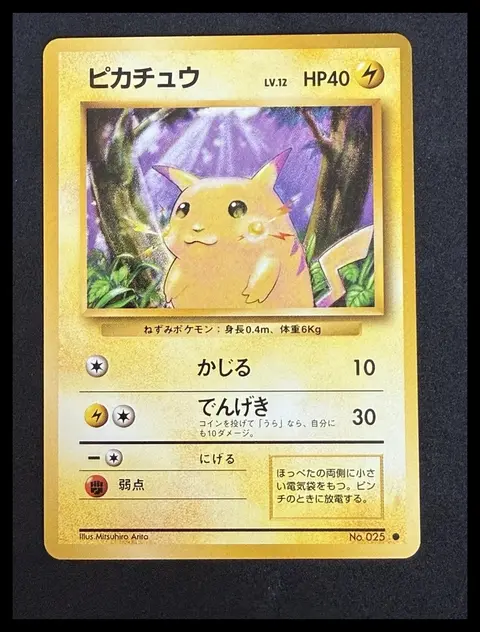
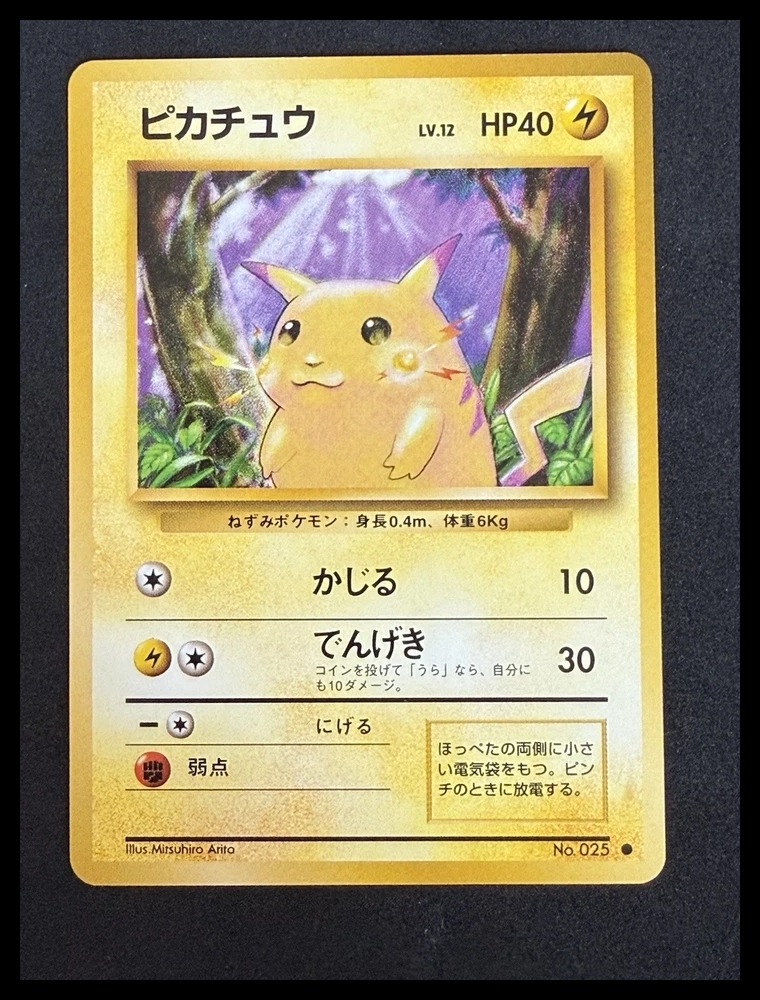
- Pikachu #25 is one of the most iconic cards in the entire Pokémon TCG, often considered the 'face' of the franchise[3].
- The card has no rarity symbol, which is characteristic of the original 1996 Japanese Expansion Pack set[3].
- High-grade copies (graded 7+) of this card have reached prices over $1,800, demonstrating its collector value[3].
Rarity and print run
- Tier
- Common
- Print run
- Very High
- First printed in
- Japanese Expansion Pack (Base Set)
- Demand
- Very High
- Supply
- High
- The card was printed in very high quantities as a common in the original 102-card set[2].
- High-grade copies (graded 8–9) are scarce due to the card's non-holographic nature and susceptibility to damage[3].
- No rarity symbol makes it visually distinct from later reprints, but this does not increase scarcity[3].
Collector notes
Condition. Key flaws to check include centering, edge wear, corner creases, and surface scratches. The card's lack of a holographic pattern means even minor scratches are more visible. Common issues include white edges from handling and corner dings that reduce graded grade[3].
Storage. Best practices include storing the card in a rigid, non-PVC sleeve (like a top loader) and keeping it in a cool, dry environment away from light. For long-term protection, consider a sealed graded or Beckett graded case[3].
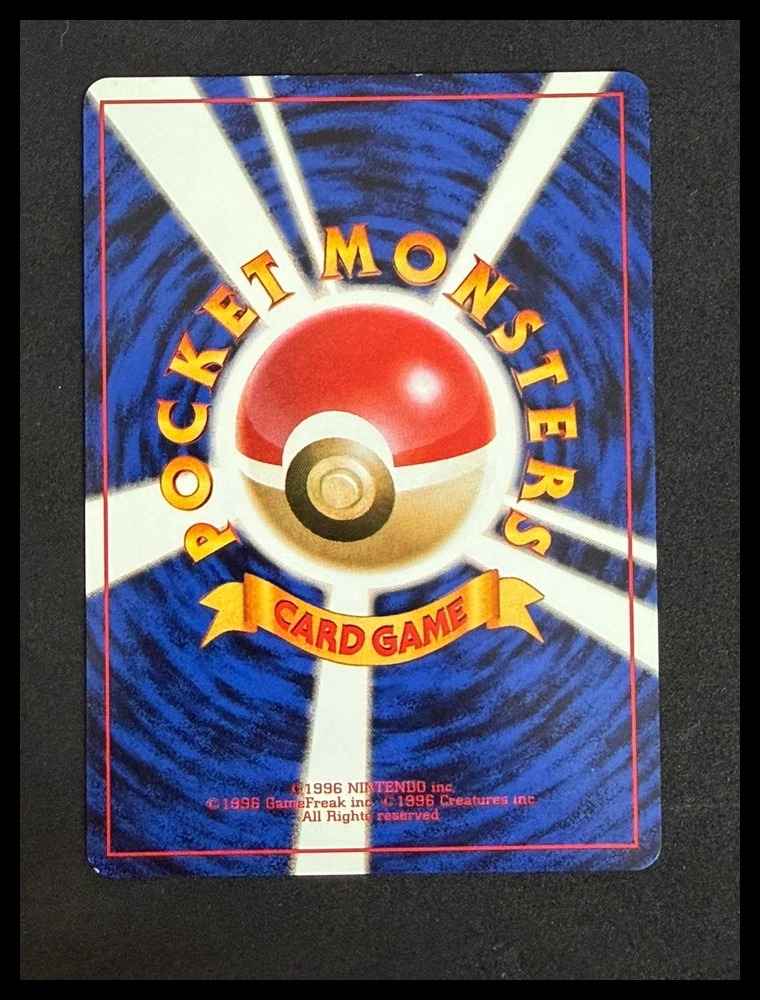
Authenticity. To spot fakes, verify the card's font matches the original Japanese 1996 printing, check for the correct Media Factory copyright text, and ensure the Pikachu image is authentic and not a reprint. Reprints often have slightly different color saturation or incorrect paper texture[9].
Sources: cardladder.com, tradingcardsets.com, pricecharting.com, tcgplayer.com, jp.pokellector.com