Market outlook
Stable Outlook 7/10
The card has persistent hobby recognition and strong nostalgia demand, but its large supply and broad availability in lower grades usually keep prices from rising sharply outside top-graded copies.[2][3]
Next months. Likely to remain range-bound with modest movement driven by condition, grading, and overall baseball card market sentiment.
Long term. High-grade examples should hold value well and may appreciate gradually, while raw/common-condition copies are more likely to stay stable with inflation-level growth at best.
History
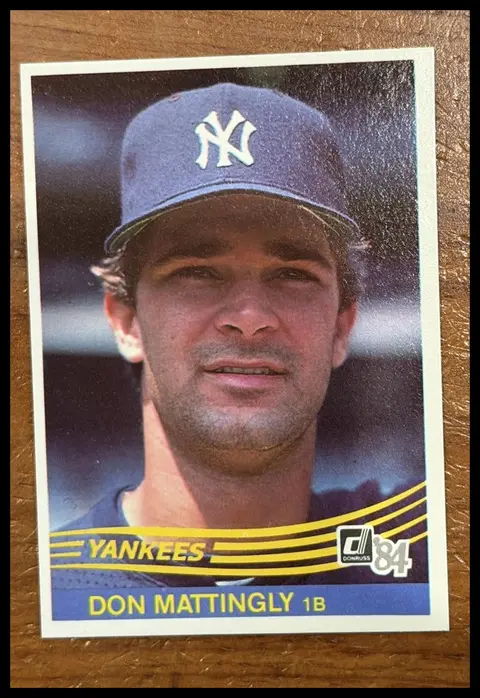
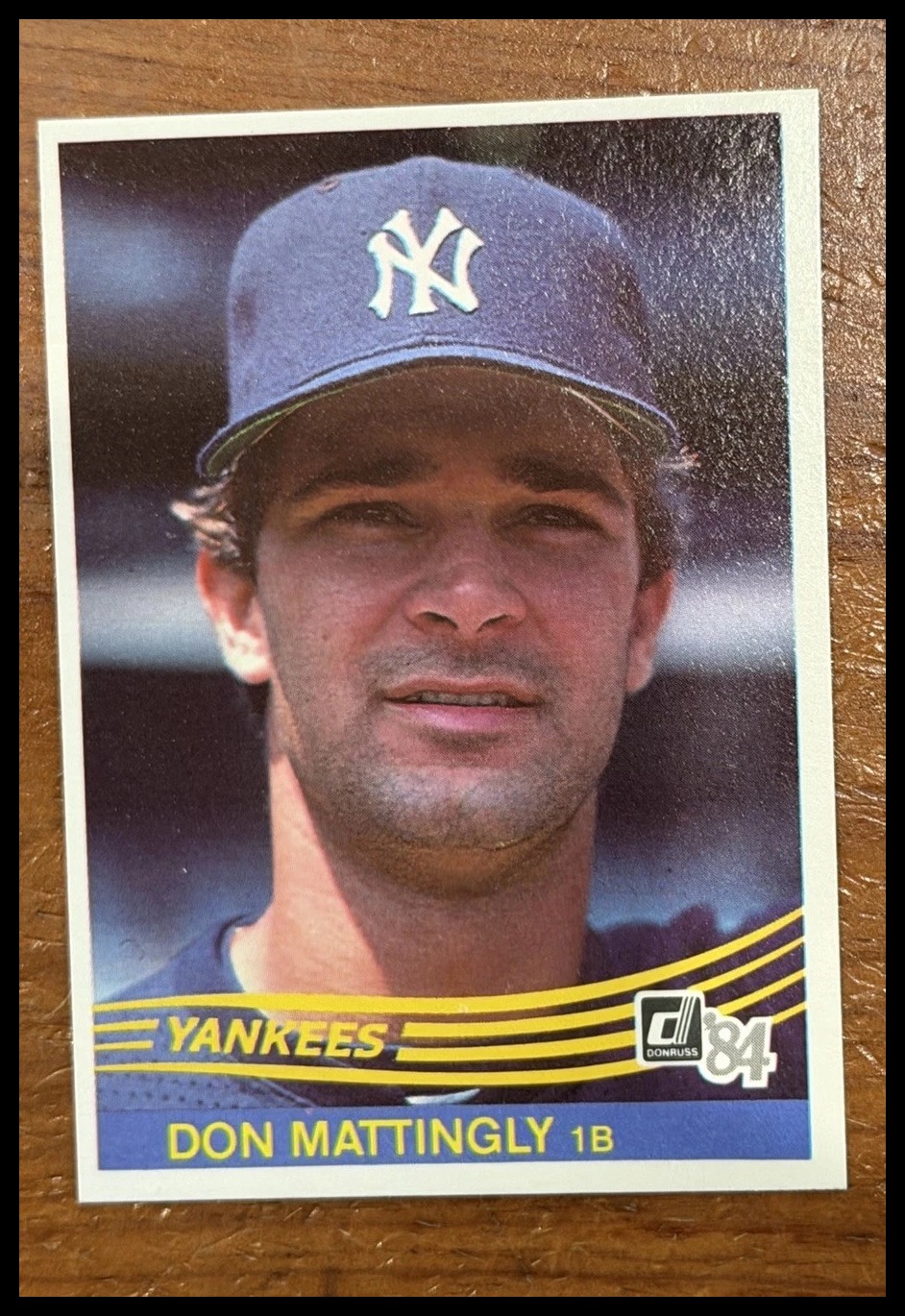
Don Mattingly is a former Major League Baseball first baseman known as 'Donnie Baseball,' best remembered as the face of the New York Yankees in the 1980s and early 1990s. He won the 1985 AL MVP award, was a nine-time Gold Glove winner, and became one of the most respected players of his era for his hitting, defense, and leadership. His 1984 Donruss card is significant because it is widely recognized as his key mainstream rookie card and became one of the most notorious and heavily counterfeited baseball cards of the 1980s.[3][4]
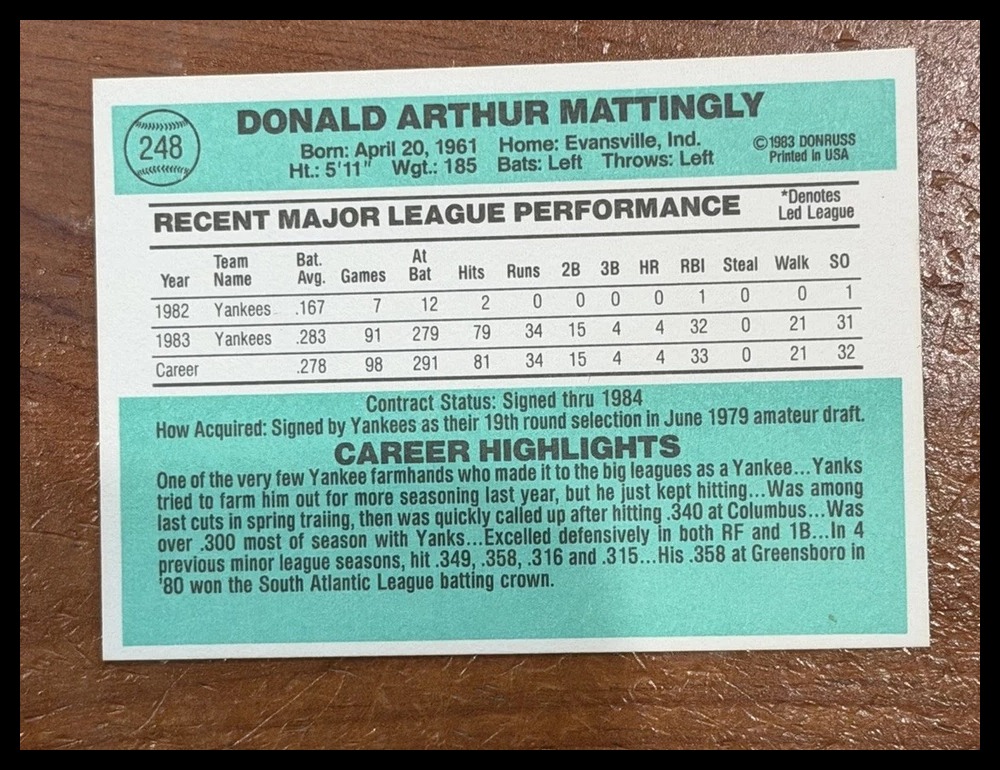
This card was first released in the 1984 Donruss baseball set, which was issued in 1984 and included Mattingly as card #248.[2][4]
- 1984 Donruss #248 is widely treated as Don Mattingly's flagship rookie card.[2][4]
- The card became infamous because counterfeit versions circulated in the hobby in the mid-to-late 1980s, helping drive the creation of more advanced anti-counterfeiting measures in the card industry.[3]
- Market guides show strong long-term collector demand, with graded gem-mint examples reaching several thousand dollars while raw copies trade much lower.[2]
Rarity and print run
- Tier
- Common
- Print run
- Very High
- First printed in
- 1984 Donruss Baseball
- Demand
- High
- Supply
- High
- Base set card from a widely distributed 1984 mainstream release
- High surviving population in raw and lower-grade condition
- True scarcity is mainly in high-grade, well-centered examples rather than overall supply
- Counterfeits increase caution, but do not make the card inherently rare
Collector notes
Condition. Check centering carefully, especially left-to-right and top-to-bottom centering, since this set is known for inconsistent alignment. Look for corner wear, edge chipping, surface print defects, and small surface scratches or print dots. Raw copies are often found with mild to significant wear, and high-grade copies are much scarcer than lower-grade examples.[2][1]
Storage. Store the card in a penny sleeve inside a semi-rigid holder or top loader, keep it in a cool and dry environment, and avoid excess handling. For higher-grade examples, use a graded holder or submit for third-party grading to preserve and document condition.
Authenticity. This card is one of the most counterfeited baseball cards of the 1980s, so compare print quality, color registration, and stock feel against verified examples. Be cautious with suspiciously sharp corners, washed-out colors, off-stock feel, or unnatural gloss. Third-party authentication and grading are strongly recommended because counterfeit examples have been a long-running issue for this card.[3]
Sources: sportscardinvestor.com, sportscardspro.com, youtube.com, psacard.com, facebook.com