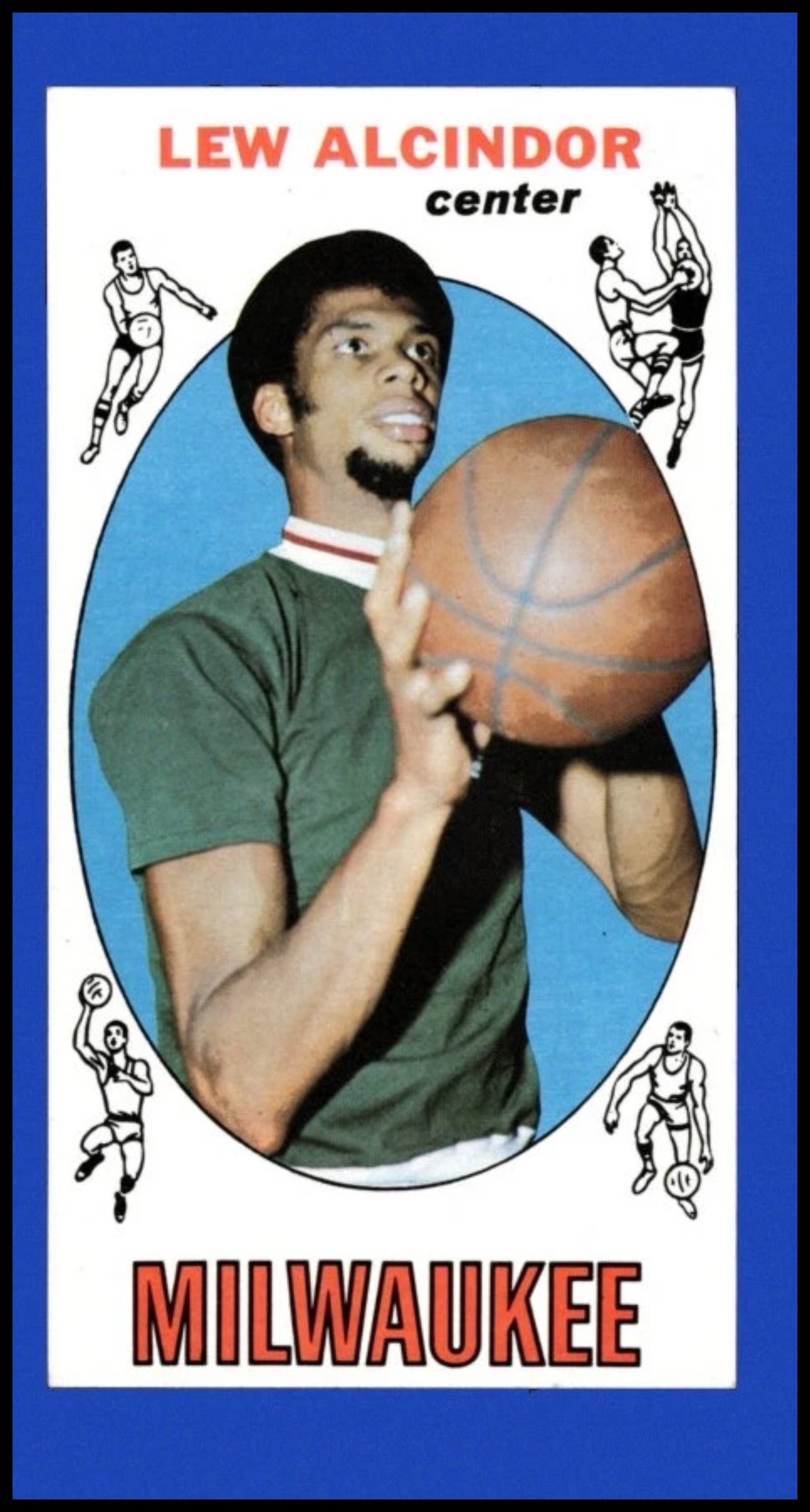
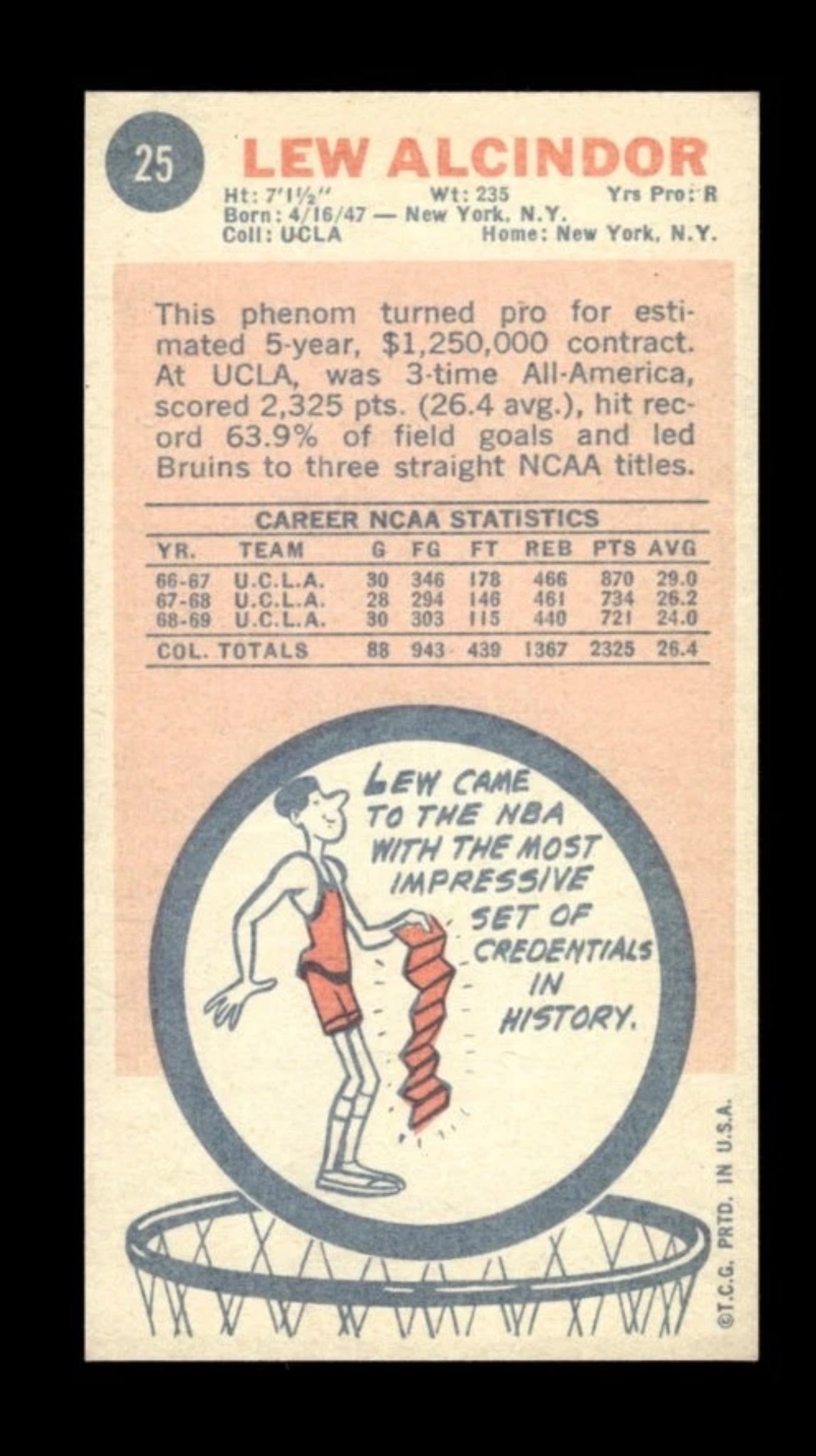
Market outlook
Rising Outlook 9/10
The card remains the foundational rookie of Kareem Abdul-Jabbar, and elite-condition population scarcity keeps upward pressure on top-end prices. Recent guide and auction data show continued demand across graded examples.[1][3][5]
Next months. Likely stable to modestly higher prices, with strong results for accurately graded mid-to-high-end copies and premium competition for exceptional examples.
Long term. Expected to remain a cornerstone basketball rookie with gradual appreciation, especially for graded 8-10 copies and strong eye-appeal examples.
History
Lew Alcindor is the name Kareem Abdul-Jabbar used during his early basketball career, including his NBA rookie era. He became one of the most significant players in basketball history, and this card captures him at the start of that professional legacy. graded describes the 1969 Topps Lew Alcindor as the only recognized rookie card of "the most prolific offensive player in NBA history."[1]
The card was first issued in the 1969 Topps Basketball set, distributed in the United States through Topps wax packs in 1969.[2]
- This is widely recognized as Lew Alcindor/Kareem Abdul-Jabbar's only recognized rookie card.[1]
- The 1969 Topps Basketball set is a 99-card issue, and the Alcindor rookie is its key card.[2]
- The card has remained one of the most important and valuable basketball rookie cards in the hobby, with graded reporting prices up to $240,000 for a graded 10 and $204,000 for a graded 9.[1]
Rarity and print run
- Tier
- Common
- Print run
- Very High
- First printed in
- 1969 Topps Basketball
- Demand
- Very High
- Supply
- Scarce
- The underlying set was a mass-market Topps release, so the card itself is not rare by original print concept.
- High-grade copies are scarce because the card is condition sensitive and difficult to find with strong centering and clean corners.[1]
- Its rarity is driven more by grading scarcity and historical importance than by low original print volume.
Collector notes
Condition. Check centering carefully, especially left-to-right and top-to-bottom. Common issues on this issue include corner wear, edge chipping, print defects, surface scuffs, and wax/stain marks from storage or pack contact. High-grade examples are scarce because even small flaws can significantly reduce value.[1][7]
Storage. Store the card in a penny sleeve and rigid top loader or semi-rigid holder, then keep it in a cool, dry, low-light environment with stable humidity. For a card of this value, professional grading and long-term slab storage are strongly preferred over raw handling.
Authenticity. Authentication should focus on print quality, paper stock, aging consistency, edges, and the integrity of any grading slab if already encapsulated. graded authentication and certification checks are commonly used in the market; suspicious examples may show unnatural whiteness, inconsistent printing patterns, altered corners, or questionable slab labels.[7]
Sources: psacard.com, throwbacksportscards.com, sportscardinvestor.com, sportscardspro.com, sports.ha.com