Market outlook
Stable Outlook 4/10
Prices for common base cards from early-2000s golf sets are generally stable because supply is plentiful and demand is driven mostly by player fandom and graded-condition interest. Mike Weir’s historical significance supports steady collector interest, but the card lacks scarcity catalysts that typically drive appreciation.
Next months. Likely to remain near current guide levels with small fluctuations based on grade and listing visibility.
Long term. Gradual, modest appreciation is possible for high-grade examples, but broad-market growth should remain limited unless golf card collecting expands materially or Mike Weir-specific demand increases.
History
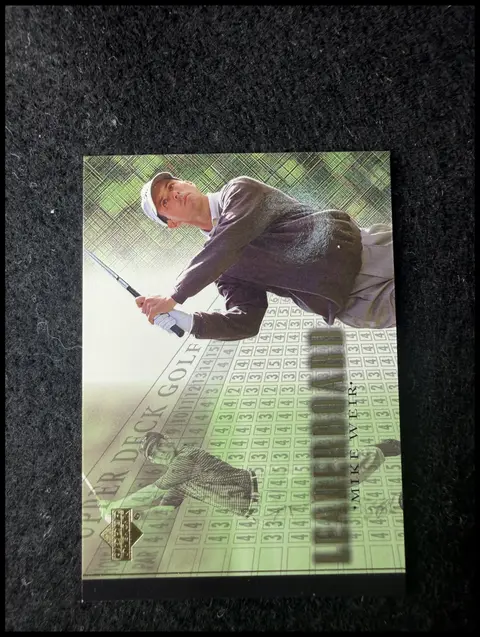
Mike Weir is a Canadian professional golfer and one of the most significant players in Canadian golf history. He rose to international prominence by winning the 2003 Masters Tournament, becoming the first Canadian man to win a major championship. In the context of early-2000s golf cards, he represents the era of emerging international PGA Tour stars alongside Tiger Woods, Sergio Garcia, and David Duval. graded CardFacts identifies Mike Weir as card #20 in 2001 Upper Deck Golf, marking him as one of the notable player cards in the base set.[4][1]
This card first appeared in the 2001 Upper Deck Golf base set, released by Upper Deck in 2001 as a golf card product featuring PGA Tour stars.[1][4][5]
- graded CardFacts lists Mike Weir among the key additions to the 2001 Upper Deck Golf set.[4]
- Jeff Allender’s checklist places Mike Weir at card number 101 in the set sequence, while other databases list his player card as #20, indicating numbering/checklist references may differ by checklist format or insert/base card indexing.[5][2][4]
- The set is historically important because it includes Tiger Woods’ rookie card and early cards of several major golf names, making the product one of Upper Deck’s most recognizable golf releases.[1][4]
Rarity and print run
- Tier
- Common
- Print run
- High
- First printed in
- 2001 Upper Deck Golf
- Demand
- Low
- Supply
- Abundant
- Base card from a major mass-produced Upper Deck release
- No serial numbering
- No autograph, memorabilia, or short-print designation
- High surviving population with many raw copies still available
Collector notes
Condition. Check centering, sharp corners, clean edges, and surface gloss. Common issues for early-2000s Upper Deck cards include minor edge wear, soft corners from loose storage, surface scuffs, and print defects such as faint roller lines or speckling. Because this is a base card, high-grade copies matter most for value.
Storage. Store in a penny sleeve and rigid top loader or semi-rigid holder, and keep in a cool, dry environment away from sunlight. For graded-value candidates, avoid handling the surface directly and consider immediate submission only if centering and corners are strong.
Authenticity. Authenticity concerns are generally low for a base card from a mainstream Upper Deck release, but collectors should still verify correct dimensions, crisp printing, accurate card stock, and consistent Upper Deck holographic/finish characteristics for the era. Reprints are uncommon, so the main risk is misidentification or damage rather than counterfeits.