Market outlook
Stable Outlook 7/10
Demand remains steady among vintage collectors due to Maris's legacy, but high supply prevents significant price growth. High-grade copies (graded 8+) may see modest appreciation due to condition scarcity [2][6].
Next months. Prices will remain stable over the next 3–6 months with minor fluctuations based on auction activity [2].
Long term. Over 1–3 years, high-grade copies may appreciate 5–10% as condition-sensitive collectors seek top-tier examples, while raw copies remain flat [2][6].
History
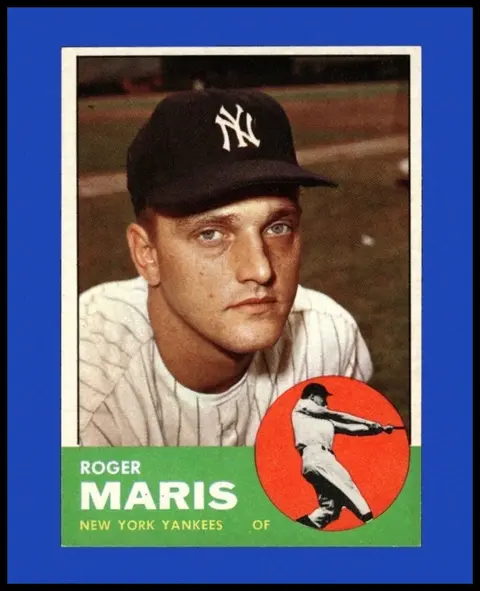
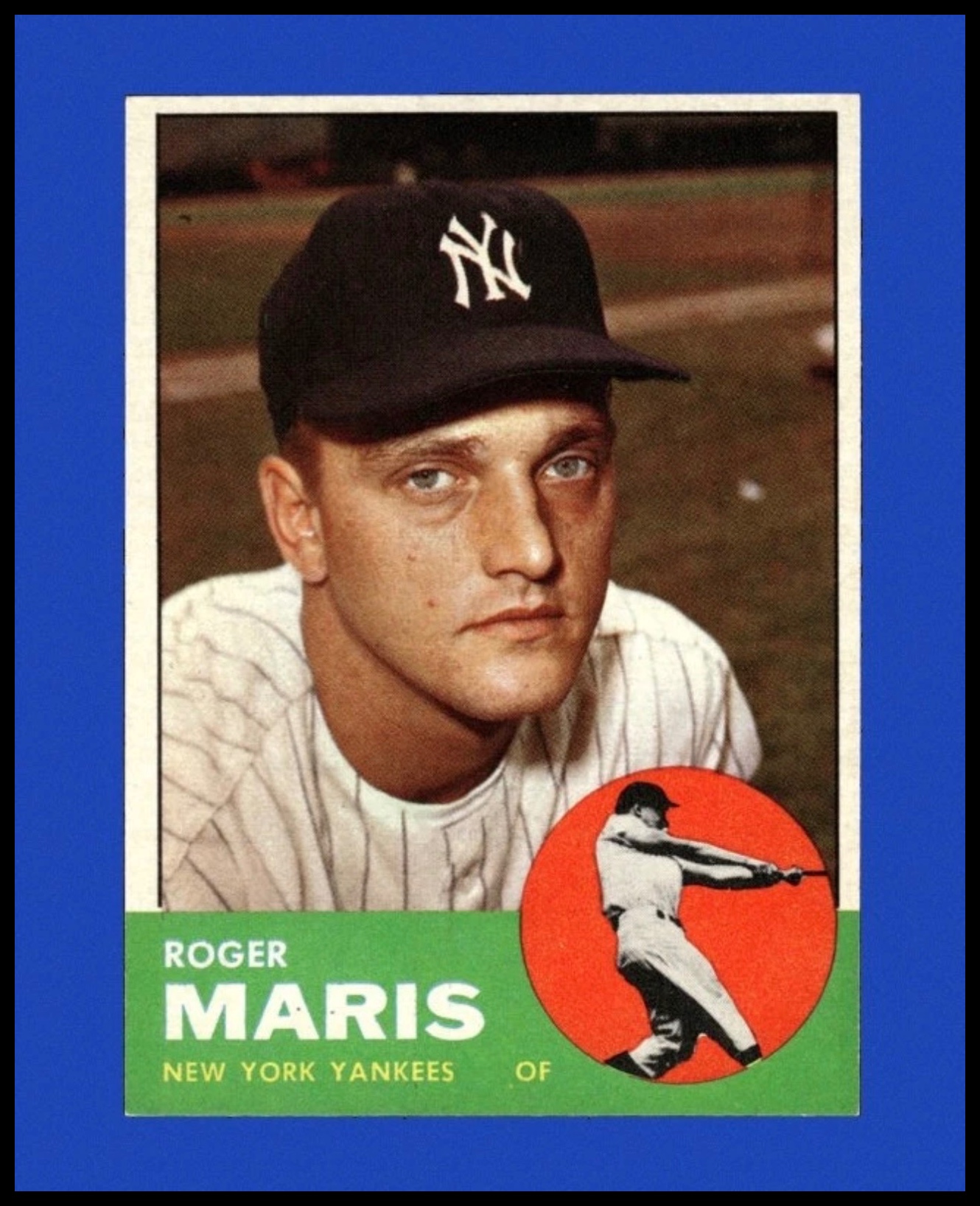
Roger Maris was a legendary New York Yankees outfielder who broke Babe Ruth's single-season home run record in 1961 with 61 home runs. The 1963 Topps #120 depicts Maris after this historic achievement, cementing his legacy as one of baseball's greatest power hitters and a Hall of Fame icon [4][6].
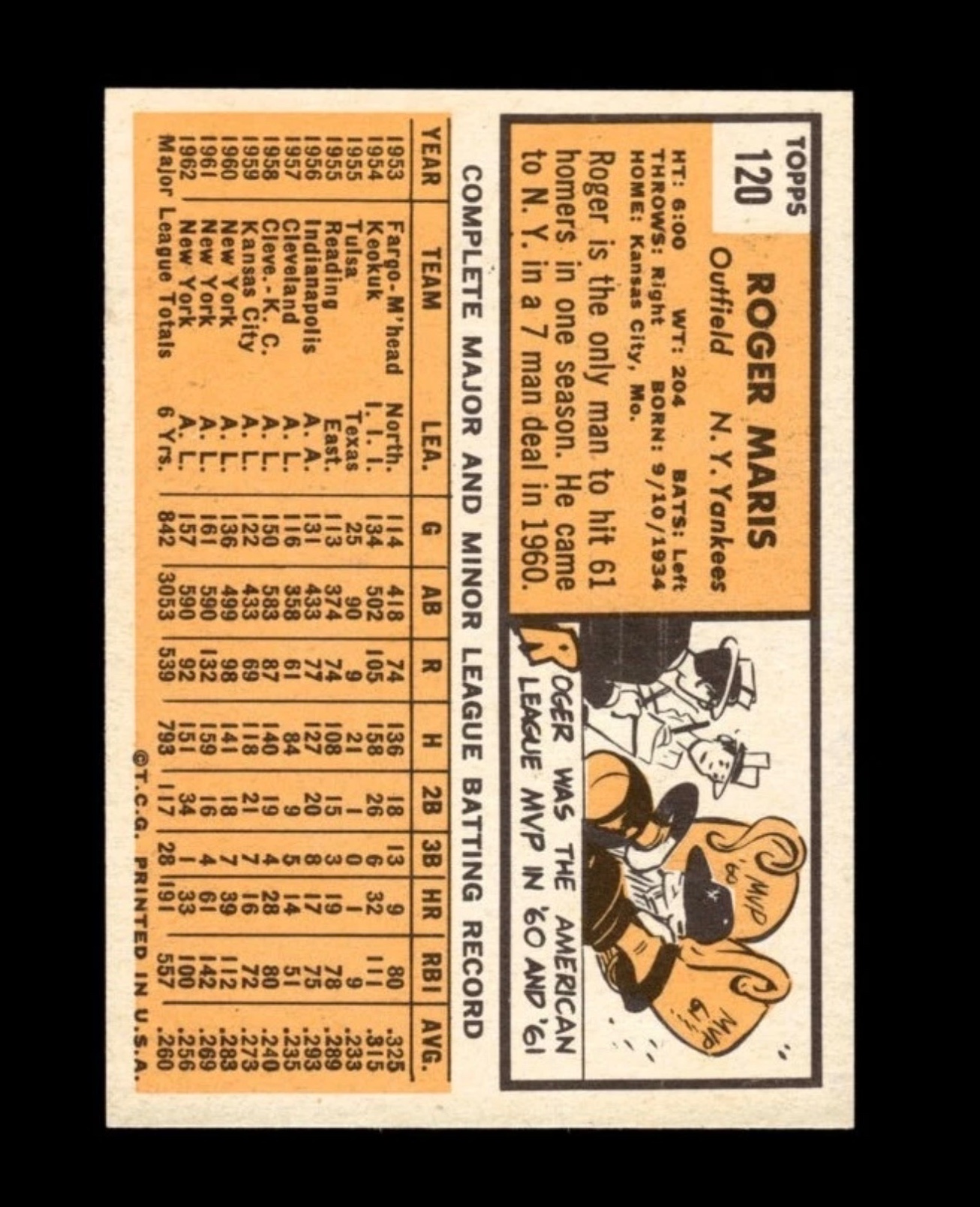
This card was first released in 1963 as part of the Topps Baseball set, printed in the United States by Topps Company, Inc. It was distributed nationwide through card shops and grocery stores [2][6].
- Roger Maris holds the record for the most home runs in a single season (61) in 1961, a record that stood until 1998 [4].
- The 1963 Topps #120 is one of the most iconic cards of Maris, featuring him post-61 HR season [4][6].
- Maris was inducted into the Baseball Hall of Fame in 1984, enhancing the long-term collectibility of his cards [6].
Rarity and print run
- Tier
- Common
- Print run
- Very High
- First printed in
- 1963 Topps Baseball
- Demand
- Medium
- Supply
- High
- Massive original print run for 1963 Topps set
- High population in graded grades (3,435 total, 213 graded 8) [2][6]
- No unusual printing errors or variants for this card number
Collector notes
Condition. Key flaws include centering issues, corner wear, and creases. The white borders of 1963 Topps cards are prone to scuffing and edge wear. Check for original gloss and absence of print lines or ink spots [2][6].
Storage. Store in a rigid top-loader or archival sleeve, keep in a cool, dry environment away from direct light, and avoid handling the card face. Use a carbon-free inner sleeve for long-term storage [2].
Authenticity. Fakes often lack the original gloss, have incorrect border thickness, or show modern printing artifacts. Reprints may lack the 'Topps' logo on the back or have different font styles. Authenticate via graded, graded, or Beckett for graded copies [2].
Sources: sportlots.com, psacard.com, youtube.com, gonos.substack.com, sportscardspro.com